The February Release That Actually Changes Something
Anthropic released Claude 3.7 Sonnet in February 2025, and for once, the marketing isn’t outpacing the engineering. This is the first model in the industry to offer a genuine hybrid reasoning mode, where developers can toggle extended thinking on or off via a simple API parameter. That architectural choice matters more than you might think at first glance. It means you’re not forced into one cognitive mode or the other. You can run fast inference when you need it, then flip a switch for the harder problems. That’s not revolutionary in isolation. What makes it worth examining is what happens when you actually measure the outcomes.

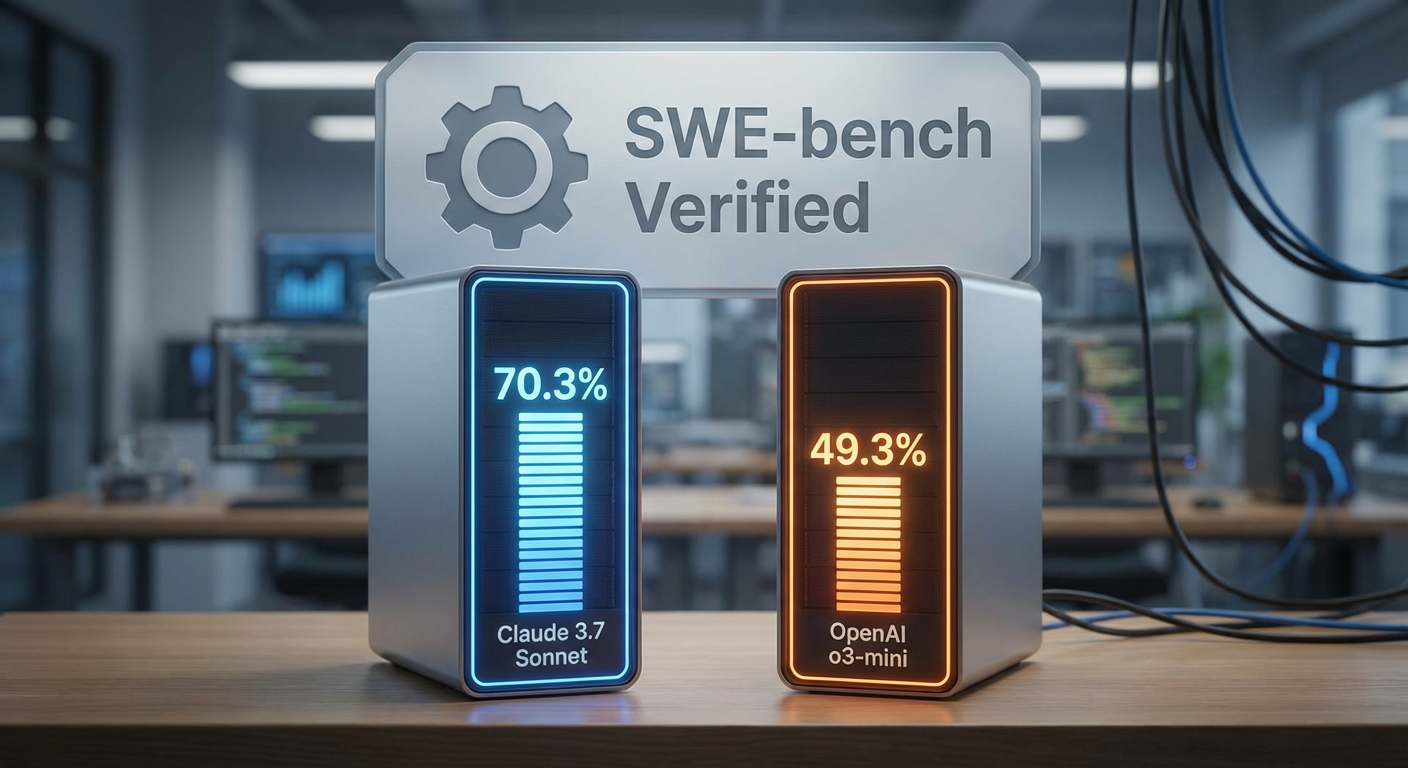
The benchmarks landing alongside this release sparked immediate debate in developer circles, and for good reason. On the SWE-bench Verified leaderboard, Claude 3.7 Sonnet scored 70.3% on autonomous software engineering tasks. That’s the gold standard for measuring whether an AI system can actually solve real coding problems end-to-end. OpenAI’s o3-mini hit 49.3% on the same benchmark. The gap is not subtle. But before you celebrate or dismiss it, let’s talk about what that number actually represents and what it doesn’t.
Reading the Benchmarks Like Someone Who’s Seen This Movie Before
I’ve watched enough benchmark cycles to develop a practiced skepticism. Numbers without context are just theater. SWE-bench Verified tests models on real, previously unseen GitHub issues, complete with the messy reality of actual codebases. It’s not a synthetic problem set. That matters. A 21-point gap between Claude 3.7 and o3-mini on a test this grounded in genuine engineering work is a meaningful signal. It’s not a typo or an artifact of how the test was constructed.
But here’s the part that gets quietly buried in the excitement: extended thinking mode is computationally expensive. Running Claude 3.7 Sonnet with extended thinking enabled increases token consumption by roughly 3 to 5 times compared to standard mode. This isn’t an academic curiosity. It’s the kind of cost multiplier that makes finance teams unhappy and forces real architectural decisions. On forums like Hacker News and inside Anthropic’s own developer Discord, teams are actively debating whether the performance gains justify the bill. Some use cases clearly do. Build a system that solves one complex problem correctly instead of solving five problems incorrectly, and you’ve already won. For high-volume scenarios or real-time assistance, though? The calculation looks different.
That’s why the honest take here is: Claude 3.7 Sonnet with extended thinking is phenomenally capable for hard problems. Without extended thinking, it’s still a strong coder, just not in that same stratosphere. The benchmark reflects the extended thinking case. The real engineering work happens when you figure out which problems actually need that mode.
The Market Just Moved Fast
GitHub Copilot, Cursor, and Codeium all integrated Claude 3.7 within weeks of release. That’s not coincidence. That’s consolidation signaling. The AI coding assistant market has been fragmented across multiple backend models. Now you’re seeing the category leaders converge on Claude because the performance envelope changed. GitHub integrating a competitor’s model into their own product tells you something about the competitive landscape. It says: we can’t ignore this.
What’s happening beneath the surface is more interesting than the headline. These tools are competing not just on model capability but on how they integrate reasoning into a human workflow. Cursor’s approach differs from GitHub’s. Codeium has its own integration philosophy. But they all recognized that whatever extended thinking mode does, ignoring it was no longer an option. You either support it and let users choose when to invoke deeper reasoning, or you lose the developers working on problems that genuinely need it.
Developer Adoption Is Past the Inflection Point
A snapshot from the February 2025 Stack Overflow developer survey shows that 76% of professional developers are now using AI coding tools daily. Compare that to the 2023 number: 44%. That’s not gradual adoption. That’s market consolidation. In two years, this went from emerging technology to standard practice for three-quarters of the survey respondents. The survey has its limitations. Stack Overflow’s sample skews toward engagement, and early adopters are always overrepresented. But the trajectory is clear. AI coding assistance is no longer novel.
What matters more is the implication for how we build systems going forward. Extended thinking modes, and the ability to toggle reasoning depth, represent a maturation of how we think about AI assistance. It’s not about having the smartest model in every scenario. It’s about having the right model for the problem at hand and calling different reasoning patterns when you need them. That’s infrastructure thinking. That’s the engineering sophistication kicking in after the initial enthusiasm phase.
Where We Actually Stand
Claude 3.7 Sonnet’s extended thinking mode is genuinely capable. The benchmarks reflect real improvement on a meaningful test. But the real story isn’t the benchmark. It’s the cost tradeoffs, the architectural implications, and the question every team building with these models now has to answer: when do I spend the tokens? The benchmarks tell you the ceiling. Engineering tells you whether you need to reach it. Both conversations matter equally.
If you’re building coding agents or AI-assisted development tools, the February release cycle deserves careful evaluation. Run your own tests against your actual workloads. Measure the token consumption in your specific use case. Then decide whether extended thinking is a feature or a luxury tax. That’s not cynicism. That’s the work of engineering. I’m curious what you’re finding in your own experiments. The real learning happens when people put these systems into production and report back on what works and what doesn’t.