The Breach That Should Have Never Happened
In late 2024, the FBI and CISA confirmed what many of us in network operations had begun to suspect: Chinese state-sponsored actors had spent over a year living inside the infrastructure of at least nine major US telecommunications carriers. AT&T, Verizon, and others found themselves explaining to regulators and customers how adversaries maintained persistent access to their networks while those networks ostensibly served as the backbone for national communications. The breach wasn’t news because it was unprecedented. It was news because it revealed something far more troubling: the gap between what we know we should do and what we’re actually doing at scale.

What made Salt Typhoon particularly striking wasn’t sophistication in the traditional sense. The attackers didn’t deploy some novel zero-day exploit that no one could have anticipated. They exploited configurations that operators have understood as dangerous for years. They moved through network management interfaces that should have been segmented. They used credentials and access patterns that basic monitoring should have caught. They won because we built the house and left the front door open, knowing full well what that meant.
Reading the Technical Autopsy
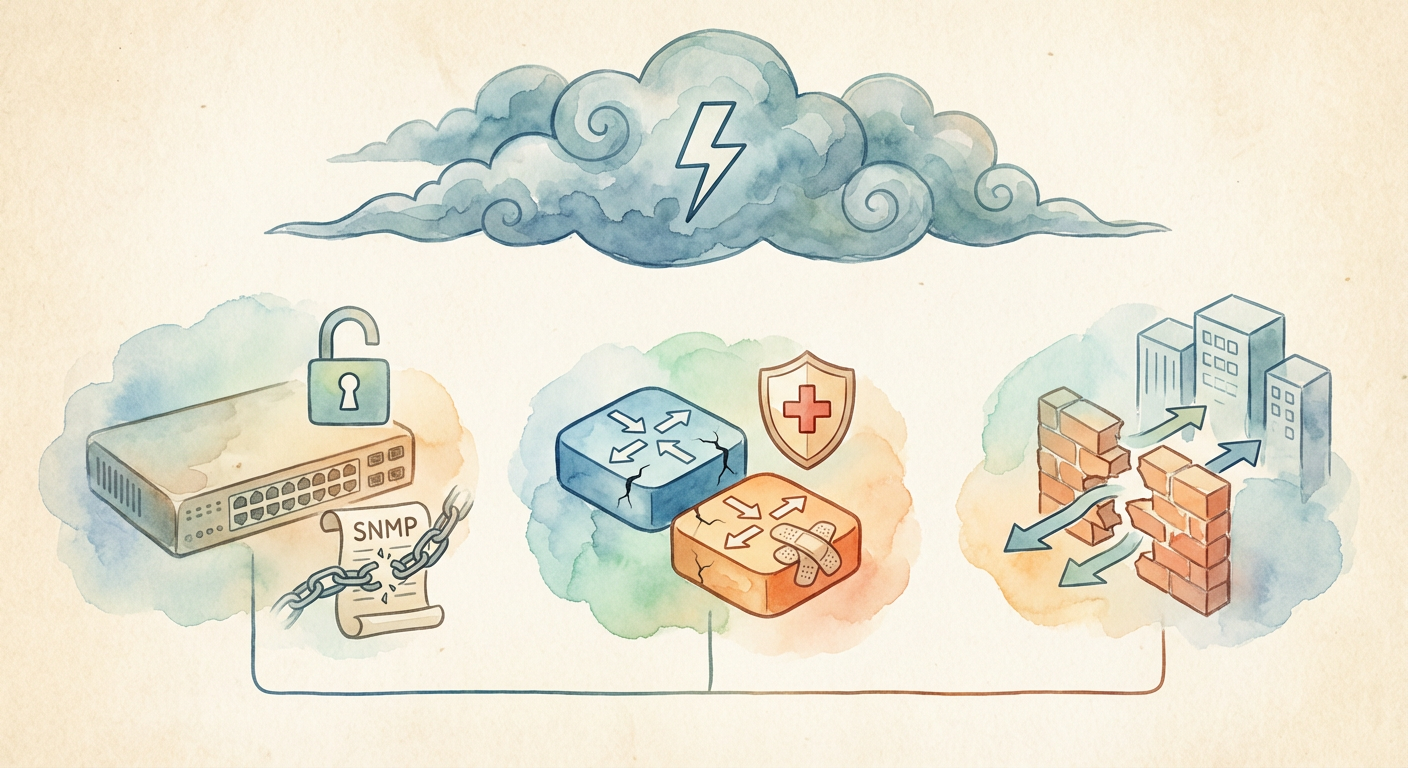
The CISA Salt Typhoon advisory laid out the primary attack vectors with clinical precision: legacy SNMP configurations that were never properly decommissioned, edge devices from Cisco and Fortinet sitting unpatched despite available patches, and network segmentation that existed more as a concept in documentation than as a reality in deployed infrastructure. When you read through the specifics, you’re not looking at cutting-edge attack methodology. You’re looking at the inevitable outcome of deferring maintenance across a complex, interconnected system.
Consider the Cisco angle specifically. In November 2024, Cisco disclosed that Salt Typhoon actors had exploited CVE-2023-20198, a vulnerability in IOS XE with a severity rating of 10.0 out of 10. The highest possible score. That patch had been available for more than a year before researchers confirmed the exploit was being actively used in the field. A year. In environments where downtime costs millions of dollars per hour, patch management becomes complicated. But when a vulnerability has a perfect severity score and the patch has existed for months before active exploitation, that calculation should resolve to exactly one answer: deploy the patch.
The broader lesson here is structural. Telecommunications infrastructure wasn’t designed with the assumption that nation-state actors would be conducting sustained espionage campaigns against it. The systems that manage these networks were built when security meant something different, when you could assume some baseline level of trust in your supply chain. They were built incrementally, with each generation of technology bolted onto the previous one rather than replacing it wholesale. Salt Typhoon didn’t expose a flaw in modern network architecture. It exposed the cost of decades of technical debt.
The Regulatory Response: From Advisory to Mandate
The traditional cybersecurity conversation happens at the policy level in a particular way: advisories are issued, recommendations are made, best practices are published. Organizations read them, implement what they think is necessary, and the cycle continues. This model relies on organizations making rational decisions about risk in their own interest. Salt Typhoon revealed how badly that model fails at critical infrastructure scale.
In January 2025, the FCC responded with new cybersecurity rules operating under Section 105 of the Communications Act. These rules require telecommunications carriers to submit annual cybersecurity risk management plans. For the first time at this level, compliance isn’t optional. It’s mandated, measurable, and a clear signal that the federal government thinks the advisory model failed and something stronger is required.
This matters for everyone building systems that touch telecommunications infrastructure or depend on it. The mandate doesn’t just affect carriers. It creates cascading requirements through their supply chains. Network equipment vendors need to think differently about patch cycles. Managed service providers need to think differently about monitoring and segmentation. Contract language between carriers and their vendors needs to reflect security obligations that weren’t explicitly stated before. The FCC cybersecurity rulemaking proceeding is still unfolding, but the direction is clear.
What Remediation Actually Looks Like
Here’s where the regulatory mandates collide with engineering reality. A Mandiant report released in February 2025 examined post-Salt Typhoon remediation efforts across affected organizations. The findings were sobering: 73 percent of compromised organizations required a full re-architecture of their carrier-grade network management interfaces. Not a patch. Not hardening. Ripping out existing infrastructure and rebuilding it to a different standard.
The financial burden reflected that scope. Average remediation costs exceeded $47 million per carrier. Let that sit for a moment. Forty-seven million dollars. That’s what it actually costs to fix the problem, not to declare it fixed. That’s what it costs when you finally decide that leaving the front door open is no longer acceptable and you need new doors, a rebuilt frame, a rethought entryway. For a mid-sized carrier, that’s three years of budget shaped entirely by decisions made in the past.
For engineers building network-adjacent systems, this remediation data is the most important part of the Salt Typhoon story. The breach happened because organizations deferred maintenance, segmentation, and patch management. The response is happening because regulators decided that deferral is no longer acceptable at this scale. If you’re designing network management interfaces, building systems that integrate with carrier infrastructure, or making architectural decisions about segmentation and monitoring, the cost of getting it wrong is now explicit and federally mandated.
What This Means for Your Architecture Decisions
The immediate translation of these events into design principles is straightforward. Assume that network management interfaces will be targeted. Design for segmentation from day one, not as an afterthought. Assume that devices will have vulnerabilities, and plan patch deployment cycles that measure weeks, not months. Assume that legacy configurations will persist longer than anyone wants. Document them, monitor them, prioritize replacing them. None of this is new. These principles have been in security literature for years. What’s changed is that ignoring them now carries explicit federal consequences.
Network security is also becoming a compliance question, not just a technical one. Architecture decisions will increasingly need to map to regulatory requirements. Design documentation will need to describe how specific federal mandates are met. Incident response procedures will need to account for notifications that go to regulators, not just to your internal team. For organizations that have historically treated security as separate from compliance, that integration is a real adjustment.
Salt Typhoon was a breach that took over a year to discover, exploiting well-known weaknesses with well-established techniques. The response has been to mandate structural changes across the entire telecommunications sector. If you’re building systems in this space, the implications for your architecture, budget, and compliance posture are no longer theoretical. They’re sitting in federal rules that take effect this year. I’m curious what you’re seeing in your own environments as these requirements begin to propagate. Practitioners working through these problems right now have important things to say, and I’d genuinely like to hear them.